Energy Audit

Our indoor environments are all unique, with different insulation systems, HVAC systems, and different appliances, with different histories, built by different people. What is common to our buildings, however, is that each one is an attempt for shelter, including a thermal-pressure boundary, attempting to maintain comfort every day of the year. All components work as a dynamic system to create comfort. Adjust one component and the others will work differently. This is where building science shines. The Comfort by Kodiak Energy Audit is a comprehensive analysis of all components, their performance, and relationships to one-another. The analysis is made easier with an array of diagnostic equipment that allows the auditor to pinpoint certain values, such as air leakage, average insulation values, equipment efficiencies, and much more. In many cases, results are intuitive, however computerized energy modeling assists with the prioritization of your recommended improvements.

Our Energy Audits include the following elements:

Consumption Analysis

kwh-on-meter

The history of your building's energy consumption provides a comparison to average and necessary inputs for estimating the savings associated with certain improvements. We extract baseload (energy used year-round) from seasonal load (energy used for comfort) to further expose your opportunities. Armed with this information, the auditor understands the energy profile of the building before we arrive for your audit.

Owner Interview & Tour

The first step with all of our customers is to learn about their home, from their perspective. The owner knows best about new systems, problem areas, comfort concerns, and future plans for the building. There may also be performance topics you want to learn more about. The interview and tour enables us to tailor the audit to your needs, and provide additional information about your concerns.

Mechanical Systems Assessment

Comfort by Kodiak conducts a thorough review of your building's mechanical equipment for heating and cooling, typically the furnace or boiler and hot water heater. We will assess the age, service history, efficiency, and venting of these appliances, and that the flues meets certain guidelines for exhausting combustion gasses. We also test for ambient Carbon Monoxide in the vicinity of all combustion appliances, which even at very small levels, may be an indication of a larger issue under certain conditions.

Insulation & Building Envelope Inspection

The thermal and pressure boundary of your building typically offers the most opportunities for improvements, as the cost of these improvements are lowest, and the impact of improvements the greatest. With the assistance of the blower door, pressure gauge, and infrared imaging, we inspect and evaluate your building's current insulation levels and the effectiveness of the installations. We do this without inspection holes. Testing combined with the auditor's experience reveals anomalies, identifying these locations for repair, and the overall R-value of the installation can be estimated. These values can be compared to current recommended values for your climate zone, and analyzed by computerized energy modeling. Modeling offers estimates of energy savings related to improvements.

Windows and doors are inspected for performance, proper installation and maintenance. Most people identify windows as the number one energy improvement for buildings, but due to their high cost, windows are often a low priority. If your windows and doors latch and seal properly, the differences between products, old and new, are marginal.

Blower Door Testing

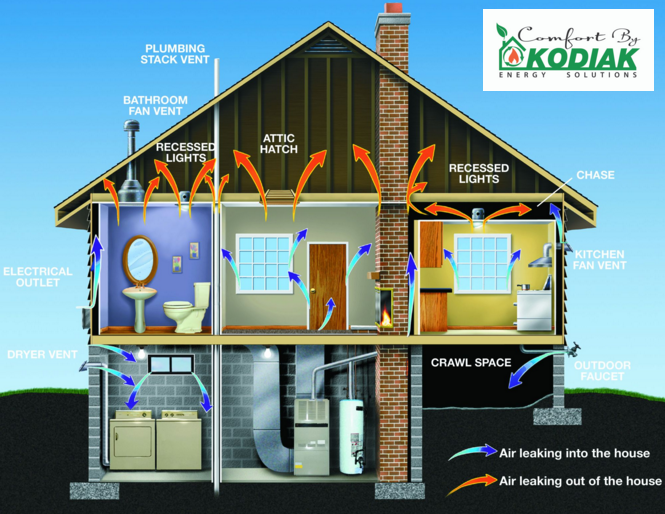
The blower door combined with a pressure gauge is one of our most powerful diagnostic tools. It allows us to quantify how much air moves through a building, and pinpoints problem locations, where by improper method or oversight, the original builder caused excessive building air leakage. We identify the air leakage issue(s) for correction, and prioritize them from large to small. Under natural conditions, convection of heat is a major source of heat loss or gain and reducing air leakage is one of the most effective ways to improve building comfort, durability, and energy efficiency.

insulationInsulationInfra-red Imaging

Often used in combination with the blower door, our infrared cameras reveal the hidden thermal deficiencies, caused either by air movement or missing or displaced insulation. With the blower door in operation and the building depressurized, outdoor air can be seen with infrared. Once again, this diagnostic tool allows us to identify and prioritize air leakage and insulation issue(s) for correction.


Our lead auditor is a Certified Thermographer, formally trained in the use of infrared cameras and interpretation of the images.  This is an important consideration when comparing energy auditing companies for the quality of the report and the accuracy of the energy audit findings.”
Thanks!

Roof Ice Assessment

Heat loss is the primary cause of ice damming on roofs. Ice dams can create puddles on roofs, and subsequent leaks, but also significantly decrease the service life of your roofing materials. Installing de-icing cable is not the solution to the problem, and only increases the amount of ice, while significantly increasing your expenses for electricity, by more than $300 each season for every 100 lineal feet. We recommend eliminating the heat loss at your roof, both through insulation and air-sealing, and allowing the roof to hold snow as is was structurally designed to do. We will describe specific improvements that achieve this condition, and enable you to abandon costly, wasteful electrical cabling.

Lighting and Appliance Assessment

The time of the Edison bulb has passed. Low-energy lighting such as compact florescent (CFL) and light emitting diodes (LED) are available in many different applications and save 75 to 90% of the energy required by incandescent bulbs. Any light that is used more than one hour per day is suspect, and offers a quick payback with replacement. We can also assist with specific analysis of your lighting needs, such as the number of lumens required at a specific location, and recommend specific fixtures to achieve the desired low-energy result.

Your major appliances such as your refrigerator, dish washer, clothes washer, dryer, and hot tub deserve consideration, and can be improved to save energy short of replacement. We will assess these items, offer suggestions for improvement, and provide information to help you decide when these items should be replaced.

Phantom electrical loads such as electronic equipment and chargers etc. can and should be controlled. We help you understand the easy ways to do it.

Health and Safety

During the Comfort by Kodiak Energy Audit, we're constantly on the lookout for dangerous conditions and pollutants negatively affecting your indoor environment. Pollutants such as Asbestos, Vermiculite, and Lead can exist in your roof, wall, and foundation systems. Radon is prevalent in the Rocky Mountains, and certain conditions lend to its accumulation. Carbon Monoxide and other poisonous combustion by-products are produced by your home heating appliances, if gas, oil or wood burning. We test for ambient Carbon Monoxide, and if present, recommend a conclusive combustion appliance zone test.

Moisture

Moisture is the enemy of all building materials, and can accumulate due to drainage issues, missing vapor barriers, and poor ventilation. Mold spores are everywhere and given a continuous source of water and food such as wood or paper, mold will grow. Using our moisture meter, hygrometer, or infrared camera, we test for accumulated moisture or elevated water vapor in your building, and if present, recommend source control measures and/or proper ventilation.

Comfort by Kodiak Building Performance Report

After we have conducted our audit, you will receive your Comfort by Kodiak Building Performance Report. The report prioritizes improvements for the various systems of your building, offering the lowest cost / highest impact items first. It also provides a complete description of our findings, and describes in detail how the improvements are made with "best practices". Additionally, we identify the myriad energy efficiency rebates and tax credits that may apply to your property to assist you in maximizing your investment.

Additional Auditing Services:

Combustion Appliance Zone (CAZ) Testing

Open combustion heating equipment has the potential to allow Carbon Monoxide and other poisonous combustion by-products into your indoor environment. A combustion appliance zone test is a conclusive method of determining whether this could happen under certain "worst case" or natural conditions, and should always be performed if air sealing is performed on the building. We perform CAZ testing in our everyday building performance operations to ensure your safety.

Duct Testing

If you have a forced-air heating and/or cooling system, leaks in your duct system can increase your utility bills and prevent your heating and cooling systems from delivering the comfort you need. If your ducts are located in an attic, crawlspace, or garage, these duct leaks are almost certain to waste energy and create air quality problems that affect your health. We perform duct leakage testing that identifies total duct leakage, duct leakage to outdoors, and pinpoints the location of duct leaks so they can be corrected.

Polutant Testing

We perform Radon, Lead, and Indoor Allergens & Mold testing.

Testimonials

Jeff B.

If you are considering trying to increase the energy efficiency and comfort of your home, you should definitely go with Comfort by Kodiak.  Dave and his crew were very knowledgeable in their assessment of our house and were very thorough in finding the major issues and correcting them.  It was amazing some of the places they found that were causing major heat loss.  Dave and the crew were very conscious of keeping the house as clean as possible during the process and their impact on our daily home life was minimal. 

Read more...